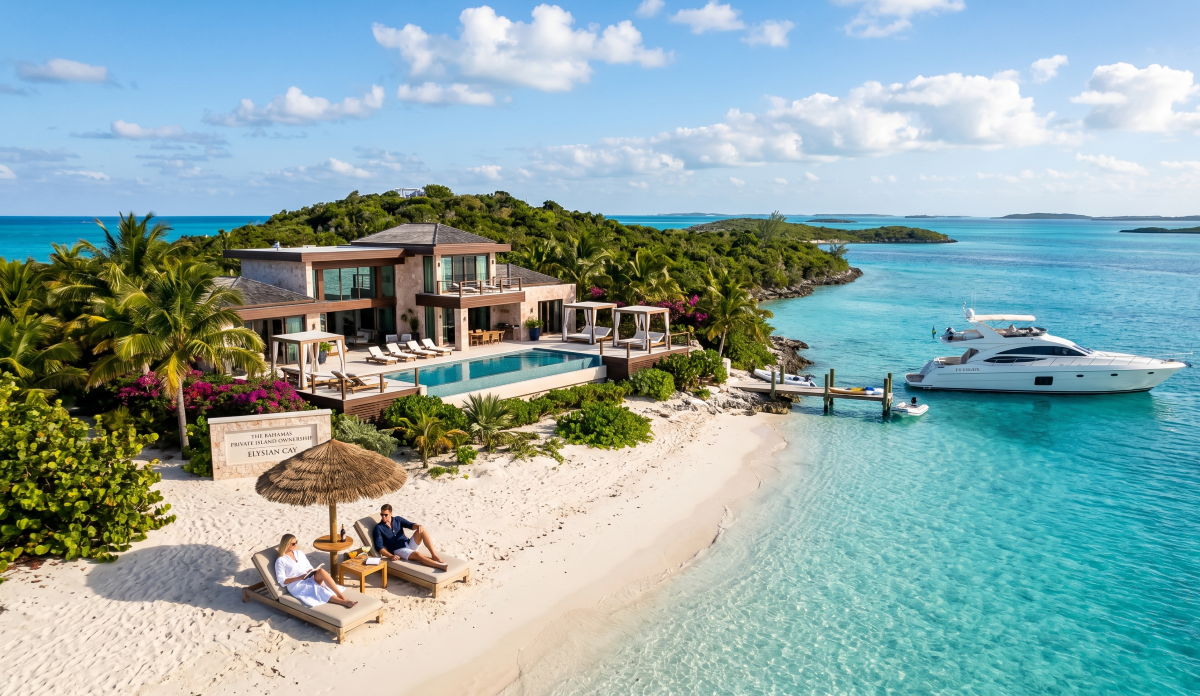
Bahamas private island ownership is more attainable than most buyers assume. This guide covers the full acquisition process — title search, infrastructure costs, environmental permitting, ownership structuring, and long-term investment value for serious buyers considering Caribbean real estate in 2026.
Bahamas private island ownership is more attainable than most buyers assume. The Bahamas holds approximately 700 islands, of which fewer than 30 are privately inhabited. That ratio tells the acquisition story better than any market report. Supply is finite. Demand from globally mobile, asset-rich buyers has never been higher. Furthermore, the process of purchasing a Bahamas private island remains poorly understood outside a narrow circle of advisors and buyers who have done it before.
This is a market where information asymmetry is the rule, not the exception. Buyers who approach private island acquisitions without regional expertise consistently encounter delays and structural problems. Careful due diligence would have surfaced these issues early. Understanding how the process works, from title to infrastructure to environmental permitting, is therefore the first and most important step any serious buyer can take.
Before evaluating any specific island, buyers should familiarize themselves with how real estate acquisition works in the Bahamas. The general framework applies to Bahamas private island purchases, with additional layers of complexity that require specialist guidance.
Bahamas private island acquisitions typically begin with a title search. This process can be complicated by generations of informal land transfers, unregistered ownership chains, and competing claims that were never formally adjudicated. Engaging a Bahamian attorney with specific experience in island acquisitions is not optional. It is, in fact, the first operational decision that determines whether a transaction proceeds cleanly or stalls for years.
The Bahamas operates under English common law. This gives foreign buyers a familiar legal framework. However, the practical reality of title in the Out Islands is often more complicated than that framework implies. Surveys that do not match recorded boundaries are a documented issue. Informal occupancy arrangements and undisclosed encumbrances are also common in this segment. Diligence performed before contract protects the buyer far more effectively than remedies attempted after closing.
Additionally, buyers should understand that title searches in the Out Islands can take considerably longer than in Nassau. As a result, building adequate time into the acquisition timeline is essential. Engaging specialists early avoids the delays that consistently affect buyers who underestimate this step.
Beyond title, the infrastructure audit matters enormously. A Bahamas private island with no existing power generation, water catchment, or road access is not simply undeveloped. It carries capital requirements that buyers frequently underestimate. Desalination systems, solar arrays, and generator backup are essential baseline investments. Moreover, dock construction and building material transport costs on remote cays can add USD 2 to 5 million to a project before a single structure breaks ground.
The Out Islands each carry different infrastructure realities. Exuma benefits from proximity to George Town and a functioning regional airport. Consequently, logistics there are considerably more manageable than on more remote cays. The Berry Islands offer exceptional anchorage conditions but more limited service infrastructure. The Abacos carry a more developed service network relative to other Out Island groups. Buyers should therefore assess which island group aligns with their intended use pattern before committing to a specific parcel.
For buyers who want to experience Exuma before committing capital, luxury villa rentals in the Bahamas across the Out Islands provide a practical and informative starting point. Several rental properties are positioned in the specific geographies relevant to Bahamas private island buyers. Spending time in the area firsthand provides direct logistical and experiential context that no market report can replicate.
The Bahamas Environment, Science and Technology Commission governs development approvals on islands touching protected marine areas. Buyers planning to develop within or adjacent to national park boundaries will encounter a more complex permitting pathway. That complexity is not prohibitive. However, it requires early engagement with regulators and environmental consultants rather than a reactive approach after purchase.
The Exuma Cays Land and Sea Park enforces strict no-take regulations across a substantial marine area. Islands within or adjacent to the park face meaningful development restrictions. Buyers who do not engage with these constraints before acquisition have consistently faced costly surprises. In contrast, buyers who engage regulators early navigate the process with significantly greater predictability.
Sustainable development is increasingly both a regulatory expectation and a buyer preference. Properties designed with solar independence, rainwater harvesting, and low-footprint architecture are not only more approvable. They are also more appealing to the eventual renter and resale buyer. BE Luxury Collection works with clients to identify island parcels where development potential is both legally viable and environmentally coherent.
Most Bahamas private island purchases are structured through Bahamian International Business Companies. The buyer holds shares of the company rather than direct land title. This structure provides privacy and simplifies future share transfer at resale. Additionally, it aligns with how most existing island ownership in the region is organized.
The specific holding structure should be determined in coordination with the buyer’s existing legal and tax counsel. It should not be determined independently. For buyers simultaneously evaluating Bahamas permanent residency through property investment, the acquisition structure becomes even more consequential. Residency applications interact with ownership records in specific ways that require coordinated planning from the outset.
Bahamas real estate at the private island level represents the most illiquid and bespoke segment of the market. For the right buyer, it is also the most compelling. There is no capital gains tax, no income tax, and no inheritance tax. Furthermore, the scarcity of genuinely available inventory creates an asset profile that very few markets globally can replicate.
Buyers who develop Bahamas private islands with managed villa rental infrastructure can offset carrying costs through Caribbean villa rental programs. Whole-island rentals in the Bahamas command among the highest per-night rates in the Caribbean. Sophisticated clientele seek exclusive buyout experiences for family events, corporate retreats, and extended private stays. As a result, income potential from well-developed Bahamas private island properties is substantial.
The selling process in the Bahamas for private island assets differs from standard residential transactions. Marketing is conducted through private networks and international brokerage partnerships rather than public listing portals. BE Luxury Collection’s partnership with Christie’s International Real Estate provides direct access to the global buyer network this asset class requires.
Buyers evaluating Bahamas private island acquisition should also understand how the broader luxury market is structured. The established neighborhoods of Lyford Cay, Old Fort Bay, and Ocean Club Estates represent the Nassau end of the spectrum. Harbour Island and the broader Eleuthera corridor show what the Out Islands look like at a more developed stage.
New development projects including Aqualina on Cable Beach and Four Seasons Residences at Ocean Club show what branded, infrastructure-complete residential product looks like in Nassau. Bahamas private island acquisition sits at the opposite end of this spectrum. It offers maximum privacy, maximum development responsibility, and maximum upside for buyers who approach it correctly.
Additionally, buyers interested in Aman’s $260 million Exuma development and Bulgari’s Cave Cay project should understand that institutional brand commitments of this scale signal a broader trajectory for the Exuma island chain. Notably, early private island positions in geographies attracting this level of brand investment carry a different risk profile than positions in less validated markets.
To explore Bahamas private island opportunities or discuss acquisition strategy across the Out Islands, connect with BE Luxury Collection. Our advisory team has direct knowledge of available inventory and the specialist legal and infrastructure relationships that Bahamas private island transactions require. Schedule a call with our team to begin the conversation. Read more Caribbean real estate analysis in The Caribbean Insider.
Exploring what is actually on the market? See our Private Island for Sale Bahamas: The 2026 Buyer’s Guide.

Follow
Intagram